The clinic raid and rescue of the captive girls
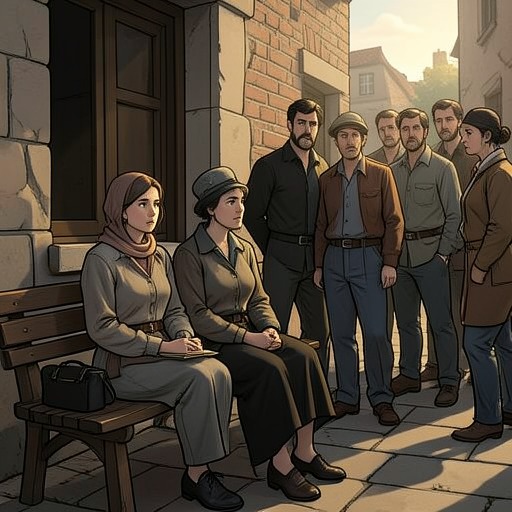
Of Fates & Fables (The Complete Series)The clinic raid and rescue of the captive girls is a decisive turning point in the campaign against Brody Harrison. Acting on Missy Quinn’s information, Romy, Talia, Justice, Kash Montgomery, and Lynch Foster enter an abandoned clinic in the woods, confront Brody’s patrols and Derek, locate the hidden basement, and lead its imprisoned women to safety. The operation does more than recover victims: it proves that the campus disappearances are part of Brody’s organized program of forced transformation, pregnancy, and pack expansion, and it gives the survivors a public place from which to reclaim their own account of what happened.
Causes and Background
Missy Quinn supplies the immediate lead. After describing her relationship with Brody and recognizing that his empty room probably means he has moved the missing girls elsewhere, she identifies the possibility of another concealed location. Her testimony links Brody’s private cruelty to the wider disappearance crisis. The raid therefore arises from accumulated evidence rather than a random search: Brody has been turning women into werewolves and forcing them to mate with males so that they become pregnant with pack offspring.
Romy understands the program as an attack on both individuals and the future of the werewolf community. Brody’s threats make the political stakes explicit: he intends to remove Kash Montgomery as alpha and claim leadership of the northeast. His treatment of the captive women is consequently not merely personal abuse but a method of building power through controlled bodies, forced reproduction, and the expansion of a loyal pack. The tattoos found on the captives make that system materially visible.
The raid also follows Romy’s own experience of captivity. She has awakened in a windowless, mildew-filled room on a cement floor, dehydrated, weak, and uncertain whether anyone knows where she is. Justice later finds her injured after Brody’s “chat,” and his alarm at her condition reveals the physical consequences of Brody’s control. Even changing clothes becomes difficult because of the injuries to her arms, while the clothes themselves become reminders of what she wants to escape. These experiences give Romy a bodily understanding of the women she is trying to reach: rescue must mean more than opening a door; it must restore safety, choice, and control over the body.
Planning and Approach
Talia takes responsibility for the practical design of the operation. She drives Anna Price’s truck while Romy and Justice use Google Earth to study the destination, identify a road in and out, and determine the best route through the woods. After an hour, Talia finds a place among dense trees large enough to park. The approach is conducted as reconnaissance rather than an open assault, with the group moving through the forest toward a structure concealed by wilderness.
The clinic appears abandoned and almost consumed by its setting. Trees have been cleared around the building, but waist-high grass borders the property, and plywood covers most of the windows. The forgotten structure has an eerie, sealed-off appearance, reinforcing the sense that Brody’s operation exists outside ordinary law and ordinary visibility. Talia wears her black ninja suit and carries multiple weapons. Romy grips the mace Talia gives her, keeps a long wand in her right boot, and carries a dagger in her left; Justice refuses weapons, relying on his teeth and claws.
The group soon learns that stealth will not last. A crash comes from inside the building, and a howl answers from the woods. Justice recognizes the danger as patrols, confirming that the clinic is defended and that the captives are not simply being hidden from casual discovery. When a wolf attacks, Romy recognizes Derek and meets the assault with a need for revenge that temporarily overwhelms her fear. The raid thus shifts from covert entry to active combat.
Combat and Discovery
Derek’s attack is interrupted when a giant mass of white fur slams into him and sends him through a wall. Lynch has arrived, and the two werewolves continue fighting among scattered metal chairs and collapsing drywall. Their confrontation creates the opening the rescuers need, but it also demonstrates the danger of entering Brody’s territory: every step toward the prisoners is made possible by a simultaneous struggle against the forces guarding them.
Kash then helps reveal the clinic’s concealed architecture. What first looks like a supply closet contains another door whose handle will not move. Kash breaks the knob from the door, exposing a short passage lit by flickering candle-shaped sconces and a staircase descending into a basement. The hidden stairs transform the building’s meaning. The clinic is not an empty medical site but a deliberately constructed prison, with its most important rooms placed below ground and accessible only through a concealed route.
At the bottom of the stairs, Kash points to a door. A girl calls from behind it, asking whether someone is there and begging for help. The voice turns the investigation into an immediate rescue. The group is no longer searching for an abstract collection of missing people; it is answering a living prisoner who has heard movement outside her cell and risks hoping that the strangers have come to free her.
The captives emerge one after another. Every girl is pregnant, wide-eyed, and marked by fear or tearful relief. They have short hair and tattoos on their necks matching Brody’s, while their identical gowns are thin, dirty, and scarcely more than rags. The visual repetition makes the breeding program legible as a system: the women have been stripped of ordinary clothing, privacy, and individual presentation, then branded as property of Brody’s pack.
The women initially hesitate when they see Kash. They know he is a wolf, and the sound of claws scraping across the floor above warns that the escape remains dangerous. Romy explains that Kash is different from Brody and his pack, pointing out that he has no tattoo marking him as one of Brody’s followers. Trust is therefore established through a visible contrast between the rescuer and the captor. Once the women accept that distinction, they begin to leave the room, one by one, with Kash leading the way.
The sequence gives Romy an active role in restoring the captives’ agency. She tells them not to be afraid and promises that the group has come to get them out. Her offered hand becomes a small but meaningful alternative to the force that has governed their captivity. The women do not leave merely because a stronger wolf commands them; they move after receiving an explanation, observing the absence of Brody’s mark, and choosing to follow the rescuers.
The raid exposes the program’s reach beyond the women themselves. One captive shows Romy the baby wrapped in cloth, revealing a rounded arm with soft rolls of baby fat and a dark tattoo marring the skin. Brody has already claimed the child symbolically, extending his system of ownership into the next generation before the infant can make any choice. The discovery makes the rescue more urgent and more complicated: freeing the mothers also means confronting the marks, identities, and inherited consequences Brody has imposed on their children.
Trauma, Testimony, and Recovery
The raid's meaning continues after the basement door opens. The rescued women are not reduced to evidence of Brody Harrison's crimes; their injuries, losses, and judgments remain part of the event. Danielle describes the cost of being forcibly turned: she has had to leave school because she cannot control her shift, lost her scholarship, and believes medical school is no longer possible. Her account shows that rescue cannot restore the life she had before captivity or transformation. Safety begins a longer process of rebuilding a future under conditions Brody has permanently altered.
The women also become witnesses who can name the structure of their abuse. Danielle confirms that the missing girls were being turned and bred, while Missy Quinn's earlier testimony explains how Brody's private domination connects to the disappearance of the others. Their statements convert rumor into a pattern: abduction, forced transformation, pregnancy, tattooing, and the confinement of mothers and children. The clinic is therefore both a crime scene and a place where silenced experience becomes collective knowledge.
Romy's responses make that knowledge personal. Her time in confinement has left her sensitive to darkness, bodily weakness, injury, and the loss of control over ordinary actions. Justice's visit finds her unable to hide the damage caused by Brody's violence, and his attempt to help her change clothes becomes an awkward but important act of care because she cannot lift her arms without pain. The rescue reverses that isolation by placing her among people whose experiences illuminate her own. Her determination to protect the captives grows from recognition rather than abstract heroism.
From Rescue to Accountability
The escaped women are brought into a safer communal setting, but the narrative refuses to treat comfort as justice. At a later baby shower for the survivors, Kaitlyn holds Hunter while insisting that gratitude for rescue must not erase the violence that made rescue necessary. She says she would never give up her child and would make the same choice again to keep him, yet stresses that none of what happened was voluntary. Her position separates love for the baby from consent to Brody's breeding program.
Kaitlyn's testimony also rejects the idea that survival requires forgiveness. She argues that Brody Harrison and his werebros must answer for what they did, even if the survivors are trying to make the best of the lives left to them. Her words reignite Romy's resolve after Romy has begun to feel guilt over the severity of her violence against Derek. The testimony supplies an ethical direction for the continuing campaign: the victims' survival is not the end of the matter, and their ability to care for their children does not absolve the perpetrators.
The infant's tattoo remains an especially concentrated symbol of that unfinished struggle. Brody's mark is visible on Hunter's body even after the mother has been removed from his control, showing how the program attempts to survive its own dismantling. The rescue frees bodies from the basement, but the community must still confront the marks, trauma, altered identities, lost education, forced pregnancies, and children produced under coercion. Liberation is consequently portrayed as material, social, and psychological rather than as a single moment of escape.
Narrative Significance
The clinic raid changes the conflict from a private danger surrounding Romy and her allies into an organized emergency affecting an entire population. The women in the basement establish that the campus disappearances are not isolated incidents and that Brody's ambition for alpha power is supported by a deliberate system of bodily control. His threatened seizure of the northeast is tied to the production of pack members, making reproduction a political weapon and the captives' bodies a battleground over leadership.
The operation also reverses the distribution of knowledge. Brody has relied on secrecy, hidden rooms, branded bodies, patrols, and fear; the rescuers answer with reconnaissance, testimony, visible distinctions between packs, and coordinated action. Talia's map work and weapons, Justice's physical strength, Lynch's intervention against Derek, Kash's destruction of the concealed door, and Romy's direct reassurance each address a different part of the prison's design. No single act explains the rescue. Its success comes from a chosen alliance assembling practical skill, supernatural power, and trust around the captives' immediate need.
Most importantly, the raid replaces Brody's definition of the women with their own emerging accounts. They are not merely missing students, breeding stock, marked bodies, or future pack members. They are survivors who can accept help, question rescuers, protect their children, describe what was done to them, and demand accountability. The clinic's hidden basement begins as a space built to conceal a population and ends as the point from which that population becomes impossible for the wider conflict to ignore.